
Tankless Water Heater, On-Demand & Instant Hot Water
Big Enough To Get The Job Done, Small Enough To Care


Tankless Water Heater Services
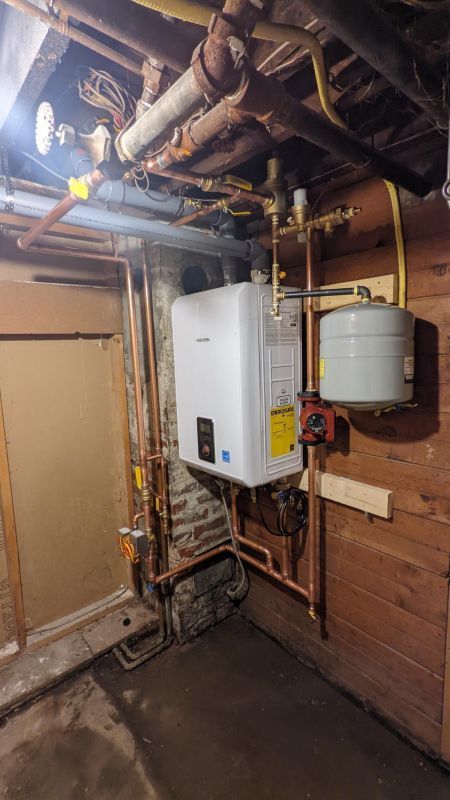
Tankless Water Heater Repair, Maintenance, Installation
24 Hour Emergency Service
If you have a heating emergency right now call now. Our same day service done by qualified technicians can install and repair any make of water heater. We offer prompt, 24-hour emergency service so that in the event of a problem, you will have your hot water heater working again in the shortest possible time.
Routine Maintenance
Regular annual service is the best way to prolong the life expectancy of your system. Tankless water heater maintenance is your best insurance policy against unexpected problems. We check everything over and look at the heating elements, check the valves and look for mineral build-up. Make sure the cold water supply is sealed and hot water hose connections are tightened.
If you are wondering about tankless hot water heater service cost, please visit our rates page. Here is a short tankless water heater maintenance checklist of models we work on.
- Rinnai tankless water heater service
- Navien tankless water heater service
- Rheem tankless water heater service
- Bosch tankless water heater service
- Bosch on demand water heater service
- Tankless electric water heater service
- Tankless gas water heater service
Tankless Water Heater Installation and Replacement
Installing or replacing a tankless water heater is a do-it-yourself job. You should hire a professional with technical knowledge and in most cases a permit is needed. This is especially true when you decide to step up from a traditional water heater to instant water on demand.
A professional heating technician is necessary as on-demand water heaters require a specialist to set things up properly. Tankless water heaters are technical units and cannot be installed from an instruction manual alone. Call us for repair or maintenance service. We can suggest add-ons like an inline filter when appropriate.
Tankless water heater: also called instantaneous, continuous flow, inline, flash, on-demand, or instant-on water heaters, are water heaters that instantly heat water as it flows through the device, and do not retain any water internally except for what is in the heat exchanger coil. Copper heat exchangers are preferred in these units because of their high thermal conductivity and ease of fabrication.
Tankless water heaters may be installed throughout a household at more than one point-of-use (POU), far from or without a central water heater, or larger centralized whole house models may still be used to provide all the hot water requirements for an entire house.
Tankless Water Heater Pros and Cons
The main advantages of a tankless water heater is a plentiful, practically limitless continuous flow of hot water (as compared to a limited flow of continuously heated hot water from conventional tank water heaters), and energy efficiency due to the use of energy only when in use, and the reduction of standby energy costs since there is no tank.
The main disadvantage of these systems are their high initial costs (equipment and installation).
How Does a Tankless Water Heater Work?
- It turns on when you open a hot-water tap (1).
- A flow sensor (2) detects water supply coming into the heater and sends a signal to the control panel to start producing hot water.
- In a gas-fired unit, the control panel (3) turns on the fan (4), which draws in outside air, opens the gas valve (5) that lets in the gas, and ignites the burner (6).
- The heat exchanger (7) captures energy efficient heat from the flames and transfers it to the water moving through the exchanger’s tubing.
- The mixing valve (8) tempers the superheated water exiting the exchanger.
- If the temperature sensor (9) detects that the water exceeds or falls short of the desired setting, the panel will adjust the gas valve, the mixing valve, and the flow-regulating hot water valve (10) accordingly.
- A sealed vent (11) (or pair of vents) through a roof or outside wall carries away exhaust gases and conveys combustion air to the burner. All this ads up to energy savings and lower energy bills.
What to Know About Tankless Water Heaters
Tankless water heaters, have become increasingly popular in recent years, and it is easy to understand why. Unlike a traditional storage tank heater that keeps a large supply of water hot around the clock, a tankless unit heats water instantly as it flows through the unit, meaning you only use energy when you actually need hot water. This can translate into energy savings of anywhere from 25 to 50 percent compared to a conventional tank heater, which is a significant reduction in your monthly utility bills over time.
Tankless units are also remarkably compact, roughly the size of a small suitcase, and can be mounted on a wall, freeing up valuable floor space in your utility room or garage. One of the biggest selling points is that you essentially never run out of hot water, making them an excellent choice for larger households with high demand. However, there are some important trade-offs to consider before making the switch.
The upfront purchase and installation cost of a tankless system is considerably higher than a traditional tank, sometimes two to three times more, and installation often requires upgrades to your gas line or electrical panel, adding further to the initial expense. Tankless units can also struggle to keep up when multiple outlets are running simultaneously, such as someone showering while the dishwasher and washing machine are both running, though installing more than one unit can solve this problem.
They also require descaling and occasional maintenance, particularly in areas with hard water, to prevent mineral buildup that can reduce efficiency and shorten the lifespan of the unit. On the plus side, tankless water heaters typically last 20 years or more, nearly double the lifespan of a conventional tank, which helps offset that higher upfront cost over time.
For the right household, a tankless water heater is a smart, long-term investment that delivers comfort, efficiency, and reliability in one compact package.
Call for a free Consultation
If you have a project you need help with, call now to speak with a plumbing expert. We can book an appointment for you with a professional plumber and look at options. If a permit is needed we can help with that and all work is done to local building code.